
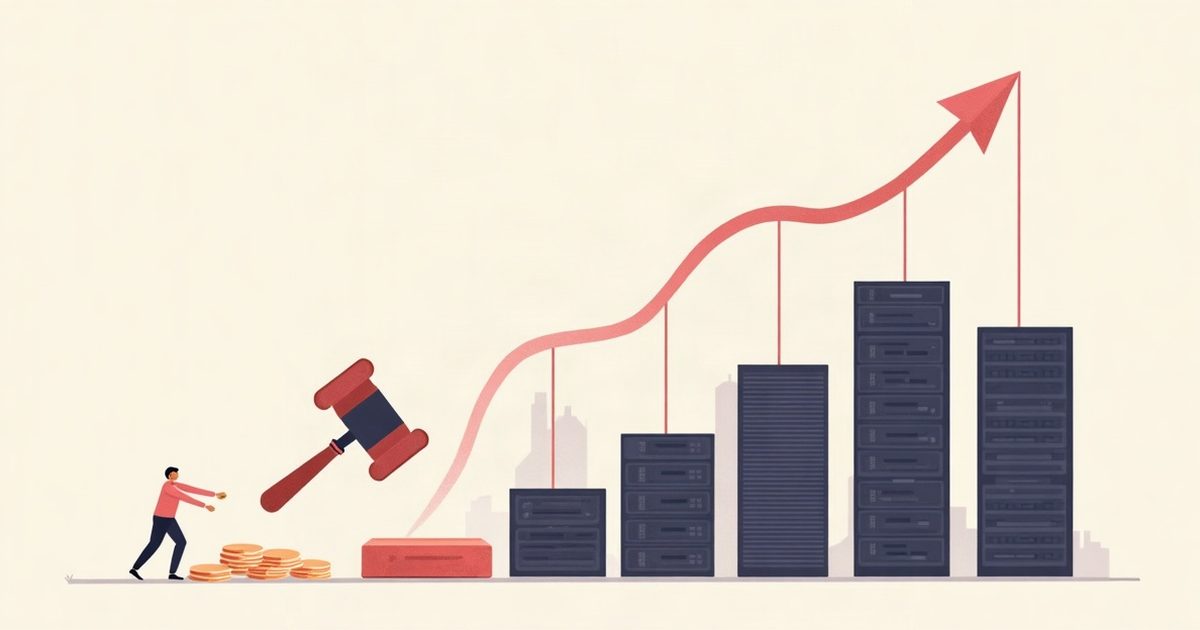
Meta's Q3 2026 results: the average price per ad rose 14% year on year, impressions 10%. Who is funding the 135 billion dollars of data centres? Your CPM.
On 21 October, Meta published its third-quarter 2026 results: 64.6 billion dollars in revenue, up 26%. Two lines in the release interest me more than all the others. Ad impressions delivered across Facebook, Instagram and WhatsApp grew 10% year on year. The average price per ad grew 14%. A week later, on 28 October, Alphabet published its own: 127.6 billion in revenue, 51.4 billion of capital expenditure in a single quarter, and a Search business slowing to +12% while queries climb. My view: the two largest sellers of advertising space in the world have just handed you the bill for their artificial intelligence, and it is denominated in CPM. If your 2027 Meta budget is the same as your 2026 one, you have just lost 14% of your contacts without deciding anything.
Meta ad prices: the series nobody reads
Every quarter, Meta publishes two figures advertisers should frame: the change in the number of impressions and the change in the average price per ad. According to its quarterly presentations, compiled by Adwize and AdsUploader, the average price rose 14% in Q4 2024, 10% in Q1 2025, 9% in Q2, 10% in Q3, 6% in Q4, then 12%, 12% and 14% over the first three quarters of 2026. Eight quarters of increases, never below 6%. In Europe, where your customers are, the price increase was 19% in Q3 2025 and 19% again in Q1 2026, before easing to 10% this quarter, with impressions up 8%. Compound it over two years, from Q3 2024 to Q3 2026: +10% then +14%, a price per ad 25% higher than it was two years ago. That is my arithmetic from Meta's figures, not a sales house's number.
What changes this quarter is the mix. Since late 2025, Meta grew on volume: impressions up 18% in Q4 2025 and 19% in Q1 2026, with prices rising more slowly. In Q3 2026, impressions slow to +10% and price accelerates to +14%. The audience, meanwhile, grows 3%: 3.64 billion daily active people. Three percent more people, ten percent more impressions, fourteen percent more price. Meta's 26% growth is paid first and foremost by you, at auction, to reach roughly the same people as a year ago.
Who funds the data centres? Your CPM
Meta spent 34.91 billion dollars on capital expenditure in the quarter, mostly servers and data centres. Against 64.6 billion in revenue, that is 54 cents invested for every dollar collected. The outlook for 2026 was narrowed to 135-145 billion dollars. The release puts it plainly: "Our AI investments are already delivering substantial incremental advertising revenue through stronger engagement, better recommendations, and more efficient monetization." More efficient monetisation, in the language of a seller of space, means more revenue per impression. In yours, it means a higher price. Mark Zuckerberg sums it up: "Our investments are paying off, the core business is strong." The core business is you.
WPP Media said it in June in its This Year Next Year report, as relayed by CB News: "The advertising industry is not a mere observer of the AI transition: it is funding it." For France, the same report forecasts an advertising market of 29.7 billion euros in 2026, up 4.9%, of which 13.56 billion for social networks and digital platforms, the market's largest line, up 7.5%, and 8.73 billion for search, up 8.4%. When the largest line in the market grows one and a half times faster than the market, and its audience grows only 3%, the difference is called inflation.
At Google, the mechanism is the same, with a different symptom. According to the figures compiled by Eric Seufert at Mobile Dev Memo and by Deepak Gupta from the quarterly 10-Q filing, Google advertising reached 82 billion dollars, up 10.6% against 14.4% the previous quarter. Search slows from 16.8% to 12%, YouTube from 12.9% to 9.2%. Paid clicks rose 8%, cost per click 4%. And for the first time, Search accounts for less than half of Alphabet's revenue, at 49.7%, because Cloud doubled. Alphabet is investing 51.36 billion in the quarter and holding its 195 to 205 billion full-year guidance. Philipp Schindler, the chief business officer, acknowledged that "the strong growth in AI Mode queries had an impact because of the lower monetization we were seeing in AI Mode", before announcing that Google is "now scaling ads within both AI Overviews and AI Mode to more users and more queries", including international markets. Translation: Google's AI earns less per query than the classic results page, so Google is going to put advertising inside the AI. I wrote in October what I think of advertising in ChatGPT; the question now walks in through the front door, at the leader in search.
Does the AI justify the increase? Do the maths
Meta's argument is well known: you pay more because the ads convert better. On the earnings call, according to AdsUploader's account, Susan Li credited the new GEM recommendation model with a nearly 2% increase in conversions on Facebook Feed, and up to 9.6% on app conversions. I do not doubt these figures. I put them next to the 14%. If your conversion rate has not improved by at least 14% in a year, your cost per acquisition on Meta has gone up, whatever the curve in Ads Manager says. Two percent more conversions against fourteen percent more price is not an efficiency gain. It is a transfer.
The real reason for the increase is not Meta's AI, it is yours. An auction knows only one variable: demand. And demand has changed in nature. When every advertiser moves to Advantage+, with broad audiences and a budget the algorithm allocates on its own, everyone bids on the same people at the same moment, and each advertiser's algorithm learns to pay what it takes to win. The conversion gains Meta announces are real, and they are immediately recaptured by price, because every advertiser reinvests them in the auction. It is exactly the glass ceiling I have described for years: beyond a certain budget, the next contact on Meta always costs more than the last one, and no model update changes that physics.
My rule against Meta inflation
A Meta budget rolled over unchanged is a 14% cut in reach: I write it in black and white in the 2027 plan, so the decision is taken, not suffered. I never steer on the ROAS the platform displays, but on incremental cost per acquisition, measured against a control area or a control audience. I cap Meta's share of the plan, and every euro above the cap goes to a medium whose price can be negotiated: broadcasters' catch-up TV at 15 to 25 euros CPM, DOOH at 4 to 9. And I do not try to negotiate with Meta, it is impossible; I negotiate with everyone else, it is my job.
What this changes in a 2027 media plan
Under 10,000 euros a month. You stay on Meta, you have no choice, and you have only one lever against price: the creative. In an auction, ad quality is the only parameter that lowers your cost without lowering your reach. A weekly routine of creative tests is worth more than any targeting setting, which in any case is now out of your hands.
Between 10,000 and 50,000 euros a month. This is where inflation hurts most, because Meta often accounts for 70 to 80% of the plan. The answer is a cap: I fix Meta's share, at half for instance, and move the rest to addressable TV, DOOH or audio, bought on a territory and measured by brand searches and direct traffic against a control area. For Comptoirs de la Bio, isochrone targeting around the stores halved the budget compared with the paper leaflet, while being 100% tracked: the lever was the plan, not the auction. I have also explained why a higher TV CPA can be more profitable than a Meta CPA: at 14% inflation a year, the gap closes on its own.
Above 50,000 euros a month. At that level you are the auction's ideal customer: you pay full price to reach people you already reach. Marketing mix modelling becomes mandatory, and it almost always says the same thing: the last third of the Meta budget returns less than the first euro placed on a screen where you are absent. For Sisley, we lifted ROAS by 45% across twelve markets without touching the brand image, by working on the allocation, not by bidding harder.
What I tell founders
Meta has not become bad. It has become expensive, and it will be more so in 2027: the fourth-quarter guidance, 73 to 76 billion dollars, is the largest bill ever presented to advertisers in three months, and it lands on your Black Friday and your Christmas. I wrote about why you should buy before the CPM spike; this year the spike has one more cause, a structural one, and it has a name: the 135 to 145 billion of data centres you co-fund at every auction. A media plan is the only place where you decide what you pay. The media mix simulator gives a first order of magnitude of what 14% of your social budget buys elsewhere. And if you want us to measure together what your last Meta euro really returns, that is what a free audit is for.