38% of French people watch YouTube on their TV set (Arcom). YouTube advertising on connected TV is television: I buy it and measure it as such. My method.
Ask a scale-up founder whether they do TV. The answer is no: too expensive, too early. Ask whether they do YouTube. The answer is yes, inside a Performance Max or Demand Gen campaign, steered on cost per conversion. So they are doing TV without knowing it, and buying it like a banner. My view: YouTube watched on a TV set is television. Same screen, same sofa, same shared attention. It has to be bought and judged as such: on reach and frequency, with a twenty-second creative that holds up on a big screen, and with measurement that happens outside the platform.
YouTube on the TV screen: the numbers you can no longer ignore
In the United States, the question is settled. In its July 2026 edition of The Gauge, published on 10 September, Nielsen measured YouTube at 14.2% of all time spent in front of a TV set. A record. Streaming as a whole reached 49.0% of TV time, broadcast 19.5%, cable 18.7%. YouTube leads the second-largest distributor, NBCUniversal and Versant combined, by five points, and Netflix sits at 7.8%. America's biggest "channel" is not a channel.
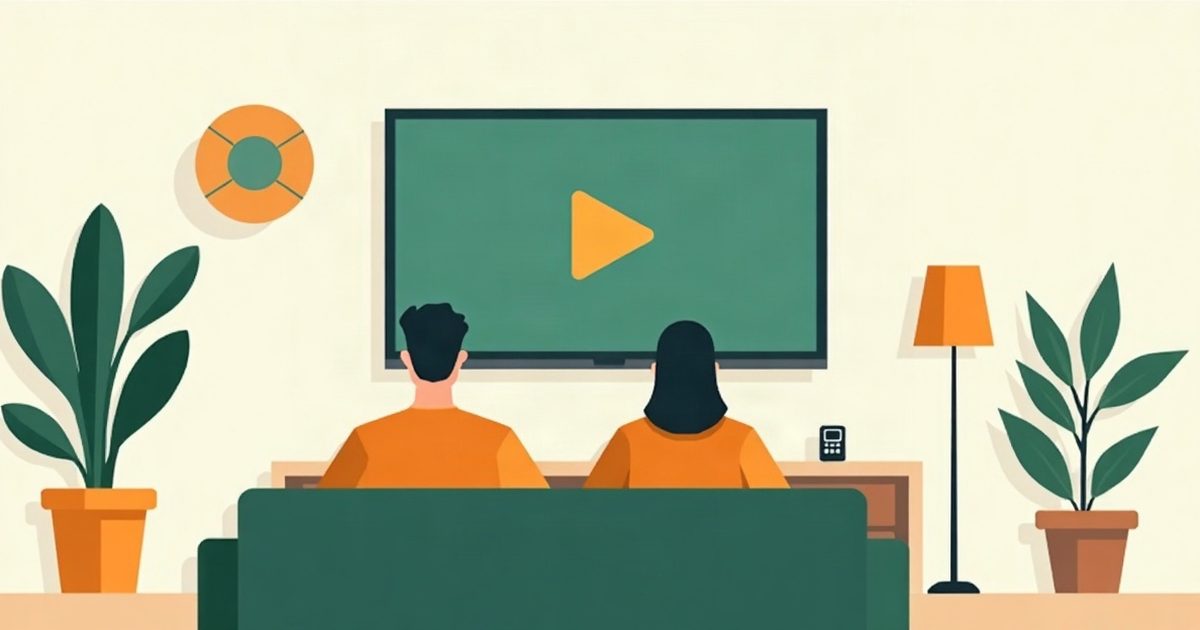
In France, the Tendances audio-vidéo 2026 study, run by CSA for the regulator Arcom among 4,308 people aged 15 and over in October 2025 and published on 31 March 2026, shows the size of the gap. Half of French people visit YouTube at least once a week, nearly 70% of under-35s. The TV set has become the third screen for watching YouTube: 66% of users, or 38% of the French population. And 28% of users do it at least three times a week.
Three details from the same study weigh more than the audience shares. For a third of users under 25, switching on YouTube has become "a reflex" when they sit down in front of the set, the first reason cited. 85% of those who watch YouTube on a TV set watch videos longer than thirty minutes there. And 93% consider the content at least as interesting as what the TV channels offer. This is not filler between two programmes. It is the programme.
Let us be precise: free linear television remains the number one video service in France, used by 90% of people. But the age pyramid tells the story. 89% of people aged 65 and over watch free channels at least three times a week. Among 15-24s, it is 50%. If your customer is 55, classic TV is still the right buy. If she is 28, the set is the same, but what is on it is called YouTube.
YouTube advertising on connected TV: the TV sales houses have already decided
The ad market understood before advertisers did. When the French TV sales houses presented their 2027 commercial terms in late September 2026, Stratégies reported that FranceTV Publicité was now including YouTube inventory in its ADspace.ia platform, that RMC BFM Ads was offering video on Brut, Instagram, CTV or YouTube for 18-49s under the name "Beyond TV", and that Canal+ Brand Solutions had placed YouTube in an "AVOD+" bundle alongside its free channels. When the channels' own sales houses sell YouTube next to their own airtime, the "TV or digital" debate is over. Two questions remain: who buys, and how you count.
On the money side, YouTube billed $11.06 billion in advertising in the second quarter of 2026, against $9.79 billion a year earlier, according to the results Alphabet published on 22 July. A 13% increase. This is not a niche on the rise. It is one of the largest media in the world, and a growing share of it is consumed on the most expensive screen in the home.
The trap: buying television on cost per click
Here is what I see in most of the accounts I audit. YouTube inventory is bought through Performance Max or Demand Gen, with a conversion objective. The algorithm does its job: it looks for the cheapest conversion. Nobody clicks on a TV set. So the machine sends your video where people click: on mobile, in the feed, in Shorts. The living-room screen, the one with attention and duration, gets the crumbs, or it is served to people who already know you and would have converted anyway. I detailed that mechanism in Advantage+ and Performance Max: how far should you let go.
Second problem: the creative. A nine-second vertical video built for the thumb, cropped onto a 55-inch screen, with overlaid text unreadable from three metres. Nobody would air that in the evening news break. Yet it runs every day on YouTube, because "it's digital".
Third problem: measurement. If you judge your YouTube TV on the cost per conversion Google attributes to it, you will always find it poor, and you will cut it. Television is not measured by the click. It is measured by what moves elsewhere: brand searches, direct traffic, sales in exposed areas. I explained how in measuring TV ROI.
My rule for YouTube on the TV screen
A separate campaign, never buried in Performance Max. A reach and frequency objective, not conversion. TV-screen inventory only, mobile excluded. A horizontal 15 to 20 second film, with sound and the brand in the first three seconds. And measurement outside the platform, the same as for a TV spot. If I cannot respect those four points, I do not buy it.
How I plan YouTube as television
I separate the campaign. A dedicated budget line, bought on CPM, in non-skippable or 15-20 second formats, targeted at connected TV screens with a frequency cap per household. The rest of YouTube, mobile and Shorts, stays in your performance campaigns. They are two different media carrying the same logo.
I produce for the living room. Horizontal format, sound on, a message you can understand without reading. On a non-skippable format you have fifteen seconds; on a skippable one, five before the button appears. In both cases the brand arrives within the first three seconds, as in a spot. If you already have a TV film, you already have the creative. If you do not, this is the moment to make one: it will serve on both screens.
I count people, not impressions. In front of a TV set, there are often several of you. TV sales houses build that in: FranceTV Publicité, for instance, announces connected TV monetised "in real advertising contacts", using Médiamétrie's co-viewing coefficients. On YouTube bought direct, you pay for impressions. To compare the two, you have to bring both back to a cost per contact. Otherwise you are comparing euros with apples.
I measure it like an offline medium. Before launch, I record brand search volume and direct traffic. Then I watch what moves during and after the campaign, ideally with an unexposed control area. For Deblock, we generated more than 30 million impressions by surrounding metro stations and geo-targeting mobile within 100 metres. What we were after was not a table of clicks: it was a brand being asked for by name. The logic is the same on the living-room screen: pressure, concentrated, repeated, and an indicator that does not belong to the seller. When the budget justifies it, marketing mix modeling splits the credit between YouTube TV, classic television and the rest.
I compare it with TV, not with Meta. The question is not "does YouTube TV convert better than my social campaigns?". It never will, on the click. The question is "to reach my target on the big screen, do I go through addressable TV, the channels' streaming platforms, YouTube, or all three?". The orders of magnitude are shifting: TF1 Pub sells a "Puissance Max" day at 6 million contacts for 100,000 euros net in 20 seconds, and the TF1 Business Partners and M6 Ad Manager platforms open the channels' airtime from 1,000 euros. The big screen is no longer reserved for big budgets. I went through the trade-off in connected TV: the power of the living-room screen.
What I tell founders
Médiamétrie's cross-media measurement, expected in 2027, will eventually put YouTube and the channels in the same table. Do not wait for it. Your customers are already in front of the same screen, and for under-35s YouTube is already the reflex there. What is missing is not the audience. It is the discipline: a separate campaign, a TV creative, counting in contacts, measurement outside the platform. Do that, and YouTube becomes your scale-up's first TV campaign, at an entry ticket television never offered.
If you want to know what share of your YouTube budget actually lands on a TV set, and what it costs you per contact, we can look at it together in a free audit. And to place the living-room screen in your plan, the media mix simulator gives a first split in two minutes.